Case Study · Brand & Marketing · 2020-2026
A marketing campaign that brings 100x ROI and saves lives at night.
By Sonesh Jain · Core Team Member, Chief of Marketing & Sales at WheelsEye, arguably India’s largest logistics-tech startup. How 10,000 reflective stickers on trucks built brand across India, delivered outsized returns, and made rear-end collisions less likely after dark.
Why I'm Writing This
This is one of the largest, most impactful, most meaningful, most satisfying, most humbling, and most challenging projects of my life. It is a highlight. And I was lucky enough to get a platform to execute it. Looking back, it was a marketing campaign that delivered roughly 100x ROI on spend. It also turned out to save lives at night, which is the part I still think about most.
I put everything I knew into this. Every instinct, every lesson from every failed experiment, every ounce of conviction I could gather. And what came out of it was something none of us could have fully predicted. Not me, not the founders, not the 600-odd people who made WheelsEye what it is.
This is a personal account. It is written from my perspective, from my memory, and with my biases. I have tried to be as honest as I can. Where credit is due, I have tried to give it. Where I don't remember the exact details, I have said so. This is not a corporate press release. This is the story as I lived it.
The Company That Nobody Knew
WheelsEye is a Gurgaon-based logistics technology startup, arguably India's largest logistics-tech startup. I was a founding member, and in the early years, I served as Chief of Marketing and Chief of Sales. I was directly working with the founders, Anshul and Manish, on building the business from scratch.
When we started, we were a nobody. Like every startup is. But our trajectory was unusual. We were growing at roughly 10x every 9 to 10 months. Unprecedented. The product was real, the business was real, the revenue was real. But for the first three years, until about 2020, we were essentially operating in stealth. We are still somewhat in stealth, but at that time, we were absolutely invisible. Nobody outside of our direct customers and partners knew our name.
And that was the paradox. The business was roaring. But the brand was silent.
For the first three years, there was no formal marketing team at WheelsEye. None. We had our basic brand identity in place (a logo, a color scheme) and we knew how to make seasonal greetings for festivals. That was the extent of our marketing capability. No ads, no campaigns, no PR. Nothing.
What we did have was sales collateral. Brochures, standees, business cards, material for our sales staff and on-ground fleet. The stuff that helps you close a deal when you're already in the room. But there was no push marketing. No effort to make the market come to us.
And here's the thing about our market: we were operating with truck owners. Truck owners in India are not digitally enabled in the way most startups assume their users are. Many of their smartphones don't even have their own email addresses set up. You can't reach them with Google Ads. You can't reach them with Instagram reels. You can't reach them with LinkedIn thought leadership. The playbooks that work for SaaS or D2C simply don't exist in this world.
"The business was growing 10x every 9 to 10 months. But at some point, we started to feel that we could do more. The reason was plain simple: not enough people knew us across the country to trust us."
At some point, the growth didn't plateau. Let me be clear about that. But we started to feel that we were leaving potential on the table. We could be growing even faster. And the bottleneck wasn't product or operations. It was trust. And trust comes from recognition. And recognition comes from visibility.
So we decided to solve for brand and visibility. Not marketing in the short-term, transactional sense. Not lead generation. Brand. The kind of thing that makes a truck owner in Salem feel like he's heard of you before your sales guy even walks through the door.
30 Experiments. Zero Results.
I ran more than 30 different types of marketing experiments over a period of about six months. Quick iterations. Different channels. Different formats. Different budgets. I was trying everything.
Ads, digital and offline. Hoardings on highways. Auto-rickshaw branding. Wall ads in industrial areas. Brochures and standees at truck stops. Campus activations. Newspaper PR in regional papers. TV news features. Affiliate marketing tie-ups. Newspaper advertisements. Social media marketing. We tried everything that was available under the roof of marketing.
And nothing worked.
I don't mean "the results were mediocre." I mean the results were not satisfying enough to justify continued investment. We had a very simple philosophy at WheelsEye, one that I deeply respect and am proud of: put your money in the right places and extract every ounce of value from your investment. If a channel isn't delivering, you don't throw more money at it hoping it'll turn around. You cut it and move on.
So after six months and more than 30 experiments, I had a lot of data on what doesn't work for marketing a logistics-tech company to truck owners in India. That data was expensive. But it was also, in hindsight, invaluable. Because it gave me real, ground-level context on the variables at play. How much budget we had. What our audience responded to. What they ignored. What the constraints of each channel were. I knew the landscape intimately.
Meanwhile, ideas were coming in from everywhere. Lunch conversations. Water cooler chats. People from different teams would chip in with suggestions. "Try this." "What about that?" "Have you considered this channel?" I was getting ideas left, right, and center. And I was in a unique position to evaluate them because I had all the context from the ground: the budget, the audience behavior, the failure modes.
What If We Put a Sticker on the Back of a Truck?
I don't remember the exact moment. I don't remember if it was my idea or if it emerged from one of those group conversations. And honestly, it doesn't matter, because the idea in its raw form was almost too simple. What if we put a WheelsEye sticker on the back of the trucks on our platform?
A straightforward thought. But we were the kind of people, at the kind of company, that didn't just run with ideas. We dissected them. We pressure-tested them. We asked the hard questions before spending a single rupee.
And the hard questions came fast:
The Questions That Shaped Everything
Scale: How many trucks can we realistically put stickers on? How many is enough to make a dent?
Permission: Why would a truck owner let us put our brand on the back of their asset? What do they get out of it beyond our logo?
Legality: Is it even legal?
Cost: How much would it cost to mobilize this at scale?
Message: What do you even write on the sticker? How do you make it memorable?
Purpose: What exactly are we solving for? Downloads? Brand recall? Trust?
Measurement: How do you measure the ROI of a sticker on a truck that's driving across the country?
That last question was the killer. With digital ads, you get instant feedback: impressions, clicks, conversions. With newspaper ads, you get at least some response metrics. With PR, you can measure coverage and reach. But how do you measure a campaign that lives on the tailgate of a truck somewhere between Jaipur and Hyderabad?
These questions didn't just challenge the idea. They ended up anchoring our entire marketing philosophy. Every subsequent decision was an answer to one of these questions: what to print, what material to use, what size to make the sticker, where to place it, how to distribute it.
The Budget Battle
The math was straightforward. To achieve any meaningful viability, any real ROI, we would need to do at least 10,000 stickers. At roughly ₹35 a piece for printing alone, that was ₹3.5 lakhs. Add installation costs (logistics of shipping stickers across the country, training ground staff, the labor of actually applying them) and the total was pushing towards ₹10 lakhs.
₹10 lakhs. For a company that had already burned through significant budget on 30+ failed experiments. For a channel with zero precedent. No one in Indian logistics had done this before. There was no benchmark data. No case study to reference. No proof that this would work.
It was really hard for me to convince the founders to allocate this budget. And I understood why. Every rupee at WheelsEye was treated with respect. We didn't have the luxury of venture-capital-funded marketing excess. We were a big company in terms of operations, but we were not that big of a company in terms of throwing money at unproven channels.
I don't exactly remember the backstory of how the approval came through. I wish I did, because it would make for a great narrative. But one Monday (I think it was a Monday) the budget was cleared. We got the green light.
And we were off.
"We were not spending money on marketing. We were investing in a hypothesis. And the hypothesis was this: if you make trucks your billboard, the trucking industry will notice."
Designing for Simplicity
The design phase was one of the most important learning experiences of my life. We created 7 different types of designs. Printed miniature versions. Brainstormed. Debated. Argued. Put them on a table and stared at them.
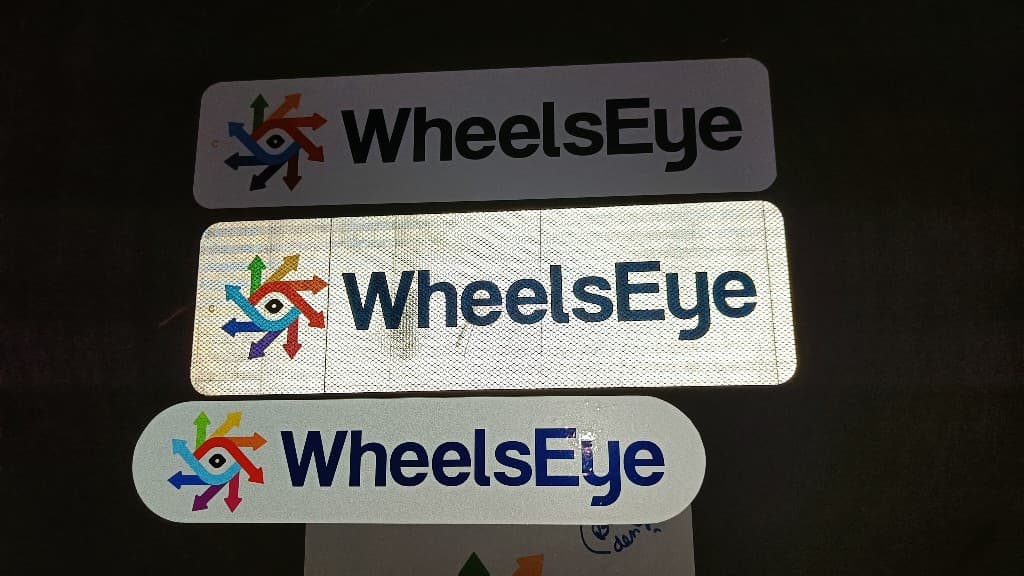
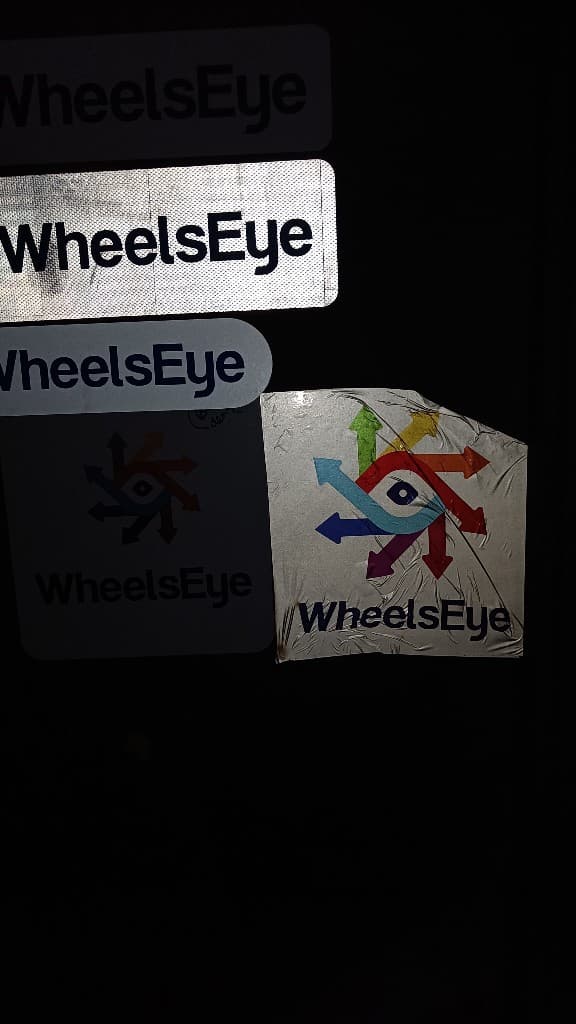
I don't have photographs from those design discussions, but I remember the conversations vividly. Different people had different instincts. Some wanted more information on the sticker: a tagline, a website URL, a list of services. Others wanted it visually striking with illustrations or graphics.
The final conclusion, and this was a collective learning not just mine, was radical simplicity. We would put just two things on the sticker:
The WheelsEye logo. And a phone number.
We had just purchased a memorable phone number: 93700-93700. Clean. Repeating. The kind of number you see once on the back of a truck at 80 km/h and still remember when you get home.
No tagline. No website. No QR code. No list of services. Just the brand and a way to reach us. That was it.
Key Learning
When your billboard is moving at highway speed and covered in dust, you get approximately 3-5 seconds of attention. In those seconds, the only thing that matters is: who are you and how do I reach you. Everything else is noise.
Field Studies Across India
This is where the project started to get intense. And, looking back, this is where it became one of the craziest field-research exercises I've ever been a part of.
We started visiting yards. Parking yards. Truck parks. Dhabas. Anywhere trucks are parked. Taking measurements. Understanding surfaces. Studying what kind of paint was on the back of different trucks. Looking at existing branding, or rather, the lack of it.
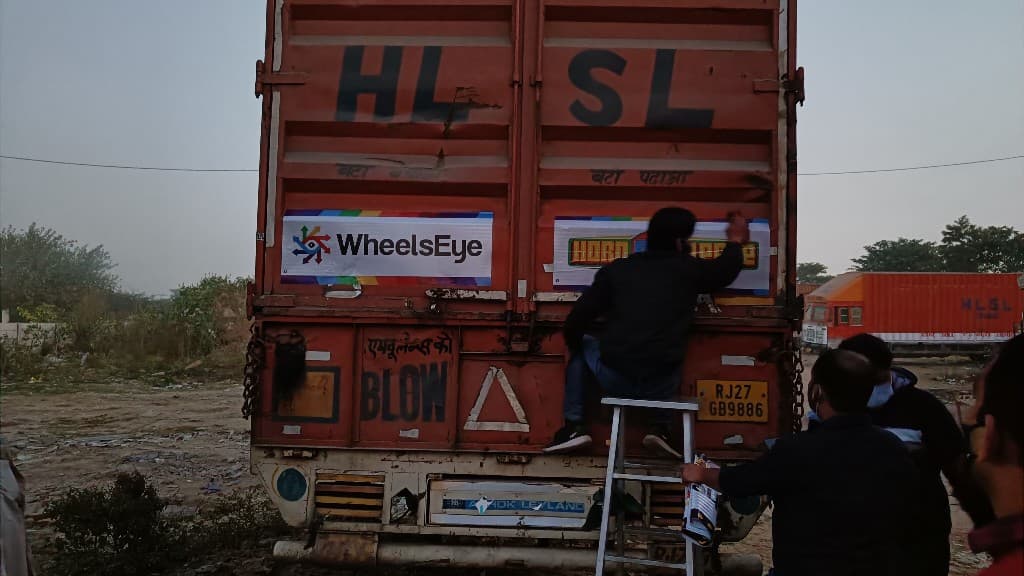
We surveyed truck owners and drivers. We listened to what they cared about, what annoyed them, what they were indifferent to. We studied placement options exhaustively. Front of the truck? Back? Sides? Inside the cabin? Each had different visibility, different durability considerations, different levels of truck owner resistance.
One answer kept coming back, blunt and practical: rear-end accidents on highways are common, and the aftermath is brutal. Court cases drag on for years. Legal fees, settlements, downtime, stress. Truck owners know the probability is not zero. Many would rather reduce that risk than argue about brand placement. A big reflective sticker on the back was not charity from us. It was cheap insurance against a nightmare they had seen play out before.
We chose the back. It was the surface following traffic sees, and it was where a reflective sticker could do the most good after dark.
Looking backward, it's easy to say it was the obvious choice. But at the time, nobody knew how any of this would turn out.
The Material Problem
Here's something most people don't think about: the back of a truck is one of the harshest environments you can put any material on.
Trucks in India run in extreme conditions. Dust. Heat that warps metal. Monsoon rain. Hail in the north. Wind pressure at highway speeds. Trucks don't have covered parking. They sit in the open, 24/7, 365 days a year. They face everything nature throws at them. And on top of all that, the surfaces are rough, uneven, often rusted, and covered in grime.
This is why, if you look at the back of Indian trucks, you'll usually see just paint. Even truck manufacturers don't put their shiny logos on the back. They save those for the front of the cabin, or for cars where maintenance is easier. The back of a truck is a hostile surface.
Standard polyvinyl stickers? Forget it. They would peel off within days in those conditions. We needed something as resilient as the truck itself.
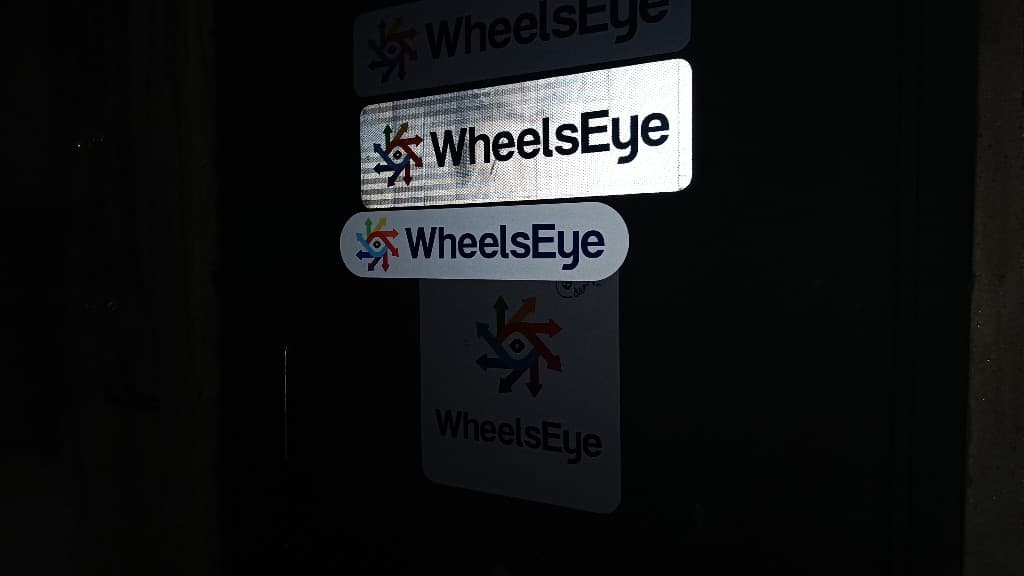
So I started visiting markets across Delhi. Evaluating different kinds of adhesive materials. Running basic adhesive tests wherever I could. There was a fire door at the back of our server room, made of metal, roughly the same surface texture as the back of a truck. I turned it into my personal testing ground. I would paste stickers, peel them off, paste different materials, observe them over days.
Then I would go to the rooftop of our office building, find a metal surface that was baking in the Delhi sun, and paste stickers there. Leave them for 3-4 days. Let them get rained on. Check if they held. Check if the colors faded. Check if the adhesive degraded.
These experiments continued for the entire duration of the project. It was a parallel track that never really stopped. I was constantly iterating on materials, on adhesive quality, on durability.
The Reflective Material That Changed Everything
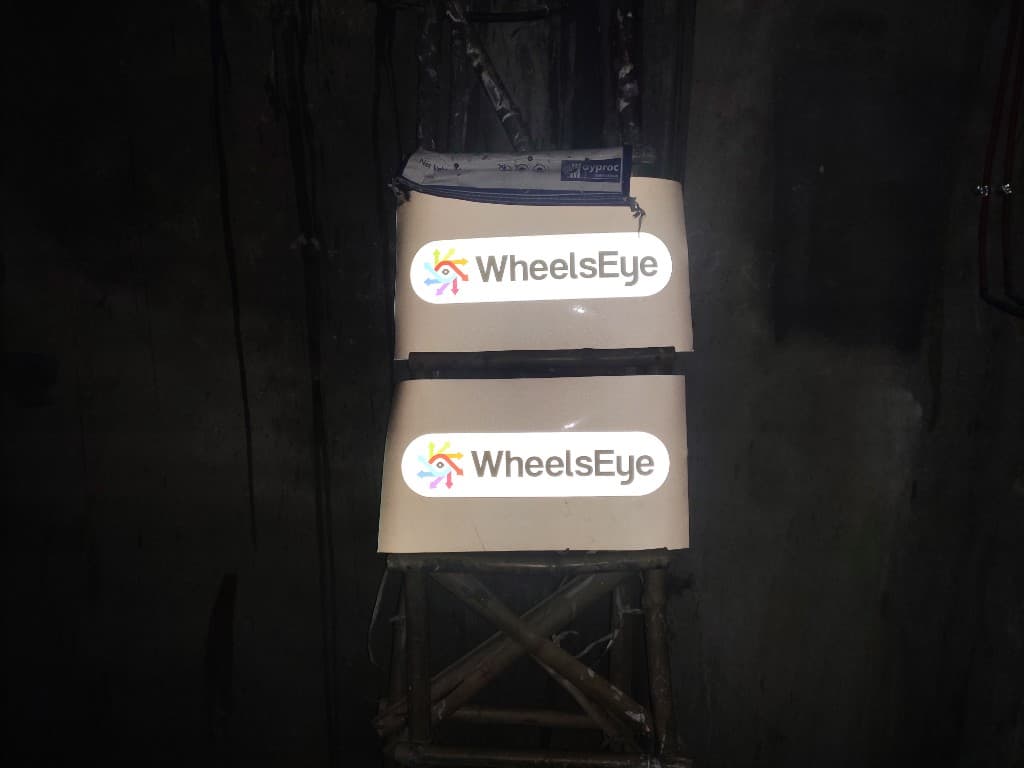
And then, during one of these material-sourcing trips, I stumbled upon something unexpected.
A reflective material. It was expensive, significantly more than anything else I'd tested. But it had properties that were extraordinary. It was composed in a hexagonal lattice structure, which meant that even if someone tried to peel it off, only tiny bits would come out. The lattice had barely-thin edges compared to the thicker body of the material, making it essentially tamper-proof. Once it went on, it stayed on.
My initial reaction was practical: "What would I do with reflective? I don't need reflection. I need durability." My benchmark was adhesion, weather resistance, strength. Reflectivity felt like a bonus.
The tamper-proof quality sealed the choice. Once it went on, it stayed on.
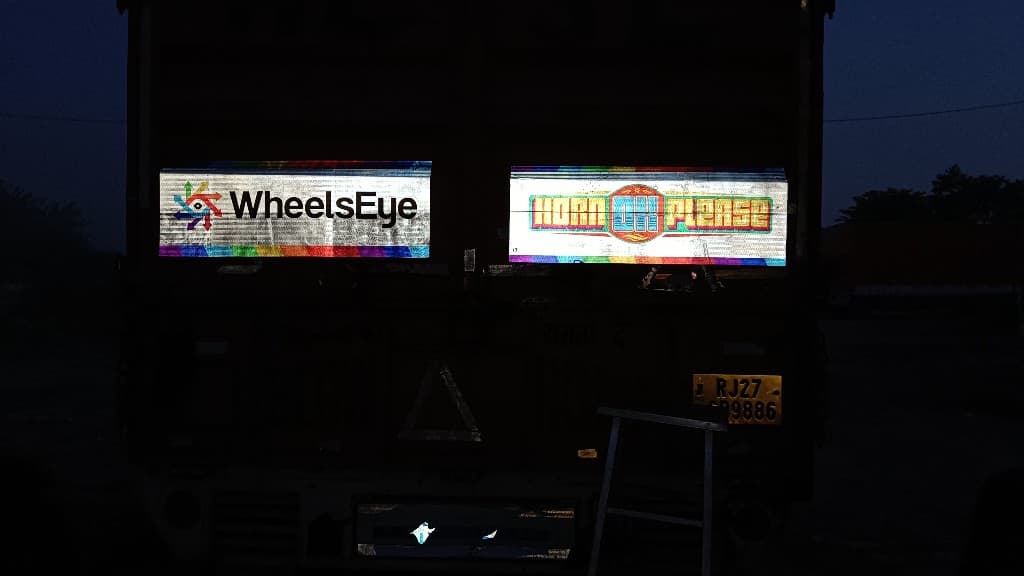
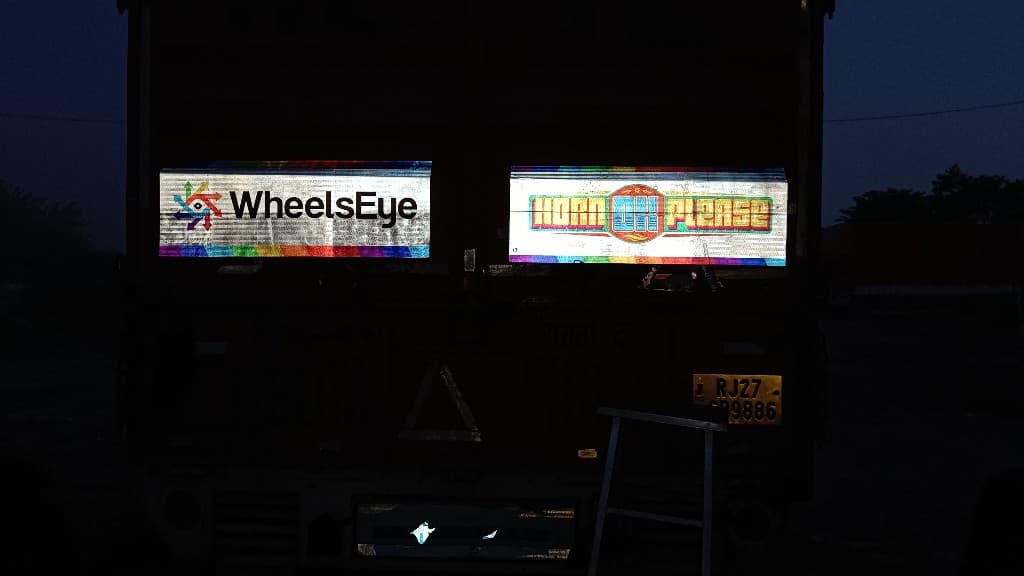
We did not fully grasp it on day one, but the reflectivity was the hidden product. At night, on Indian highways, a glowing tailgate is not marketing fluff. It is the difference between being seen and being hit. That is why truck owners eventually said yes in large numbers. The hassle of a court case after a rear-end collision, which many of them knew was a real probability, was simply not worth skipping a free reflective marking.
The Dimension Game
With the material chosen, we moved to dimensions. And this turned out to be an optimization problem with real constraints.
My instinct was to go big. I designed something around 20-25 inches wide and about 8 inches tall. Big logo. Big phone number. Maximum visibility. If you're going to put a sticker on a truck, make it count.
But raw material comes in rolls with fixed dimensions. And you can only cut a fixed number of stickers from one roll. Bigger stickers meant fewer per roll. Fewer per roll meant the budget would exhaust at just a few hundred trucks, far short of our 10,000 target.
So I sat with the printer. Multiple times. We would compute the optimum size, calculate the number of stickers per roll, figure out print time, estimate manpower needed. Then we'd iterate. Change a dimension by an inch. Recalculate everything. Change it again.
Two, three iterations would happen in a single sitting. And then I'd go back the next day with new constraints or new information and we'd do it again.
The final dimensions were smaller than my original design, a compromise between visibility and volume. But it was the right compromise. Every dimension decision cascaded into other variables: how fast could we print, how many people would we need, how much would it cost per unit, how many trucks could we cover, and how soon could we finish the project.
The Optimization Cascade
Sticker size → stickers per roll → rolls needed → print cost → print time → manpower → distribution logistics → timeline → total trucks covered → minimum viable impact. Every variable was connected. Change one, and the entire model shifted.
The Chaos of Execution at Scale
Budget: approved. Material: chosen. Design: finalized. Dimensions: optimized. Stickers: printed.
Now came the hardest part. Putting 10,000 stickers on 10,000 trucks across the length and breadth of India.
There was no dedicated branding team. These stickers would be applied by our existing on-ground staff, people who were already doing sales, installations, and fleet management. I was essentially asking people who already had full-time jobs to take on one more responsibility. This was a lean project in the truest sense. We had to prove the worth of this initiative before we could justify asking for more resources.
We sent stickers out to field teams across the country. Trained them through videos and phone calls on how to apply them. Our small team of 3-4 people was fielding hundreds of calls.
Imagine receiving 100 calls in a day, each one requiring you to explain the how and the why. Some people were enthusiastic. Everybody wanted to be part of the experiment, part of a potential success. But with enthusiasm came chaos.
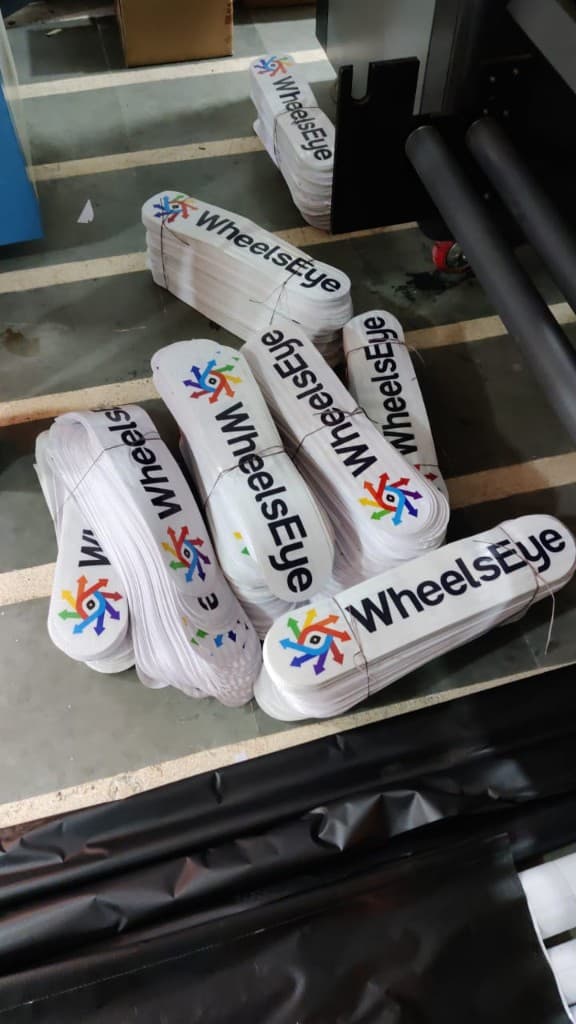
Some field staff complained that the stickers didn't fit their trucks, because, of course, you can't make one size that fits every truck model in India. Some stickers arrived damaged in transit. Some people were pasting stickers on dusty, dirty trucks without cleaning the surface first, which meant the adhesive stuck to the dust instead of the metal. Those stickers would peel off within days, wasting material, wasting effort.
We were losing stickers to improper application. We were losing stickers to shipping damage. We were losing stickers to the sheer diversity of truck surfaces across India.
But things were moving. Fast. The numbers were climbing. The map was filling up. And we were trusting the process.
The Silence
Weeks passed. Nothing.
No signal that anything was happening. No feedback from the market. No change in sales conversations. No uptick in inbound calls to 93700-93700. Just silence.
More weeks passed. Maybe a couple of months. We had finished the first batch of 10,000 stickers. I had gone through the process of getting approval for a second batch of 10,000, because the infrastructure was now in place. Training was done. Distribution channels were established. The only incremental cost was printing. The argument for a second batch was strong on paper.
But there was still no real signal that any of this was working.
And then, one day, something happened.
Spotted in Salem
WheelsEye had a company-wide WhatsApp group. Everybody was on it, from the founders to the field staff in the smallest towns.
One day, a message appeared on the group. A field team member from a tier-2 town had received a text from a relative, someone he hadn't heard from in maybe a couple of years. The relative had spotted a truck with a WheelsEye sticker. And they were proud. "I saw a truck from the company where you work. Wow. You're working at such a big company."
Then another message. Then another.
And then the floodgates opened.
"Spotted in Gulbarga. Spotted in Salem. Spotted in Jammu. Spotted in Rajasthan. For a week, the entire company WhatsApp group was on fire. People were clicking pictures of WheelsEye trucks in their towns and sharing them with pride."
It was a frenzy. For an entire week, the group was flooded with photographs. People were spotting WheelsEye trucks in cities and towns across India and sharing the sightings like they'd spotted a celebrity. They would write the city name like a badge of honor: "Spotted in Nellore." "Spotted in Indore." "Spotted in Siliguri."
Family members of employees, people who had no connection to WheelsEye other than knowing someone who worked there, were texting their relatives to say they'd seen the brand on the road. The 600-odd employees of WheelsEye had an extended network of maybe 2,000-3,000 people across India. And suddenly, all of those people were seeing WheelsEye on the highways and feeling a personal connection to it.
That was the moment. That was the signal we had been waiting for, for months. And it came not from a dashboard or an analytics tool, but from WhatsApp messages from relatives in tier-2 towns.
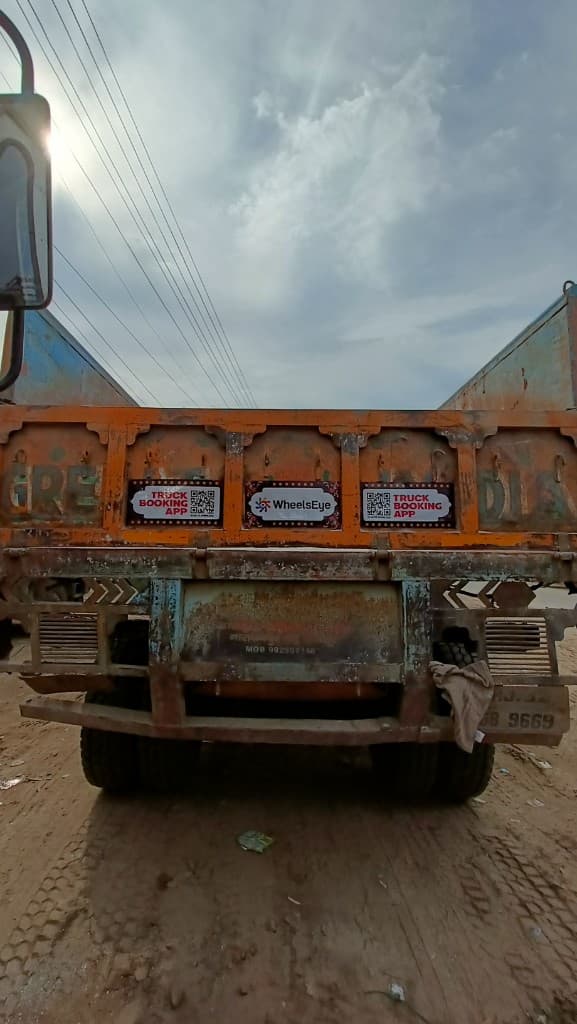
The "spotted in" phenomenon. Organic, unplanned, and more powerful than any ad campaign we could have bought.
The Behavioral Shift
Before the stickers, this is what our sales conversations looked like:
You go and knock on a truck owner's door. "Hi, we're WheelsEye. We have a solution for fleet management. We can help you with GPS tracking, trip optimization..." And they'd cut you off. In their heads, you were just another GPS company. Just another startup. Just another IIT guy knocking on their door with a pitch deck and a dream. Most of the time, you were denied entry. When you did get in, you weren't taken seriously.
After the stickers, the dynamic flipped.
People wanted to meet us. Sometimes, the truck owner was already waiting. They had seen our brand on trucks in their yard, on the highway, in their town. They had context. They had a frame of reference. The cold call was no longer cold.
The biggest personal validator came at an industry conference. There were leaders of big companies: banks, oil companies, fleet service providers. The entire trucking ecosystem was represented. We were a small team of 3-4 people from WheelsEye at this event.
The Managing Director of a major bank walked up to me and said: "Are you from WheelsEye? I've seen your trucks everywhere."
My colleague, who was leading our fuel business, introduced himself to a senior leader at one of India's largest oil companies. The moment he said "WheelsEye," the response was immediate: "Oh, yeah. WheelsEye. Of course. Very good."
This wasn't a marketing metric. This was something far more valuable. This was recognition without introduction.
Surgical, Not Spray-and-Pray
I want to pause here and emphasize something, because this is the most important strategic insight of the entire project.
Most marketing creates noise. It is imprecise by design. You spend money to reach a million people, hoping that a few thousand will care. You spray and pray. You throw ads at a wall and hope something sticks.
What we did was the opposite. It was surgical.
Our stickers were on the backs of trucks. Who sees the back of a truck? Other trucks. Other truck owners. Truck drivers. People at truck stops. People at warehouses and loading docks. People at fuel stations on the highway. People in the logistics and transportation ecosystem.
In other words: exactly our target audience. And nobody else.
If you were a bank giving loans to truck owners, you saw WheelsEye every day. If you were a fuel company serving the trucking industry, you saw WheelsEye every day. If you were selling truck parts, servicing trucks, insuring trucks, financing trucks, you saw WheelsEye every day. If you belonged to the trucking or transportation industry in any capacity, you knew WheelsEye.
And if you were a consumer sitting in your car on the highway? You might have seen a WheelsEye sticker, but you probably didn't care. And that was fine. Because you were never our customer. We weren't wasting a single rupee of impression on people who didn't matter to our business.
This was not noise. This was signal. Precisely targeted, organically distributed, impossible to ignore if you were in the industry.
The Reflective Sticker Saves Lives
Remember the reflective material I chose for durability? The hexagonal lattice that was tamper-proof and weather-resistant? The reflectivity that I initially dismissed as irrelevant?
This is the section that still gives me chills.
If you search "car accident" on Google News right now, there is an almost certain chance you will find a recent story about a car ramming into the back of a truck at night. This is one of the most common types of fatal accidents on Indian highways. Trucks parked on the roadside at night, with no reflective markings, are invisible to oncoming traffic until it's too late.
Many trucks in India don't have proper reflective markings on the back. It's a regulatory gap, a compliance gap, and a deadly one.
Our stickers were reflective. And they were big. And we were putting them on thousands of trucks.
"We chose the material because it would not come off. It turned out that it also made trucks visible at night. That is when we understood we were not just buying billboards. We were putting safety markings on thousands of vehicles."
When a car's headlights hit the back of a truck carrying a WheelsEye sticker, the sticker lit up. It made the truck visible from a distance. It gave the driver behind enough time to slow down, change lanes, avoid a collision.
And this is what answered the foundational question we'd been wrestling with from day one: Why would a truck owner let us put our brand on the back of their asset?
Because our sticker protected their asset. A reflective sticker reduces the chance of a rear-end collision, the kind of accident that can total a truck, drain a truck owner of lakhs of rupees, and pull them into years of court proceedings. The social anxiety alone is exhausting. Truck owners told us plainly: the probability of trouble is high enough that a free reflective marking on the back is a fair trade for a bit of brand space. They were getting protection. In exchange, we got brand real estate.
It was a genuine value exchange. Not a coercive one. Not a transactional one. A win-win that neither side fully understood at the beginning, but that became clearer with every passing month.
Why Owners Said Yes
The value exchange was practical, not poetic. Rear-end collisions on highways are common. The legal aftermath is slow, expensive, and stressful. Owners who had lived through that, or watched peers go through it, did not need a lecture on reflectivity. They agreed to the sticker because reducing night-time visibility risk was worth more than the pride of a clean tailgate.
Some truck owners, to be honest, did not like the idea. There was a love-hate relationship. Some were vocal about not wanting someone else's brand on their asset, and I respect that entirely. But many, perhaps most, came around once they understood the safety benefit. "Let them have the space. I get a free reflective sticker that protects my vehicle. Fair deal."
Scaling Into Hundreds of Designs
After the initial success with the logo-and-phone-number sticker, something shifted. We had found a channel. A real, working, proven channel. And now the question was no longer "does this work?" but "how far can we take this?"
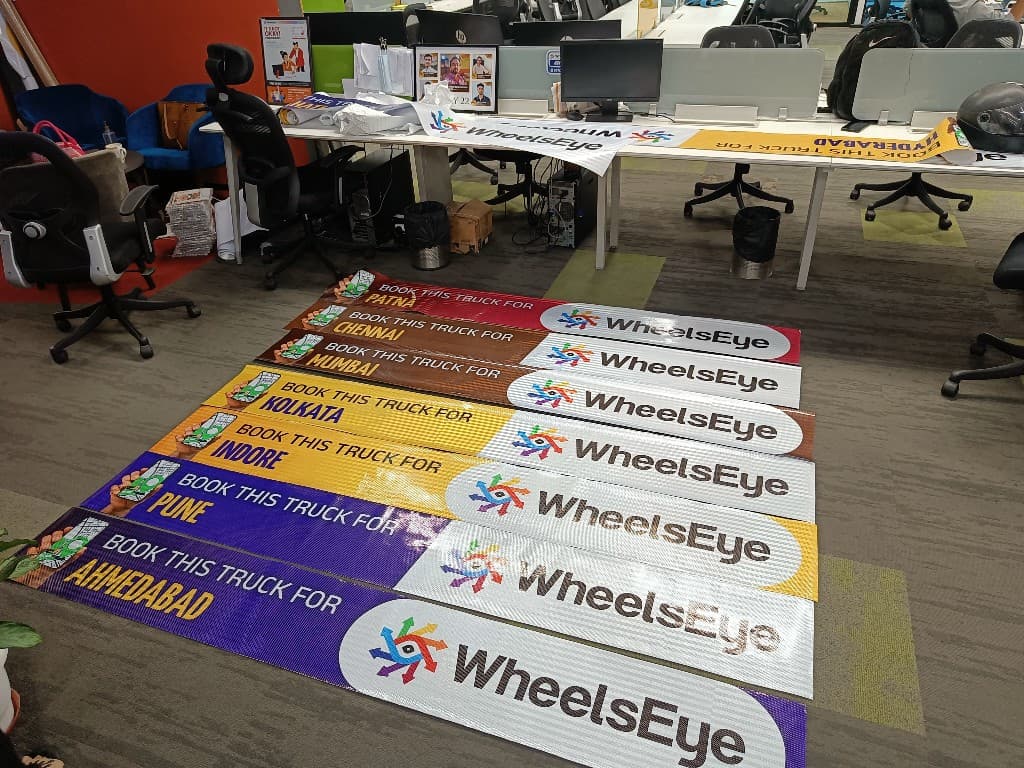
From the original 7 designs, we went to hundreds. We created, iterated, tested, discarded, refined. In the end, we shortlisted 26 designs and put 16 different versions into production. Each design served a different purpose.
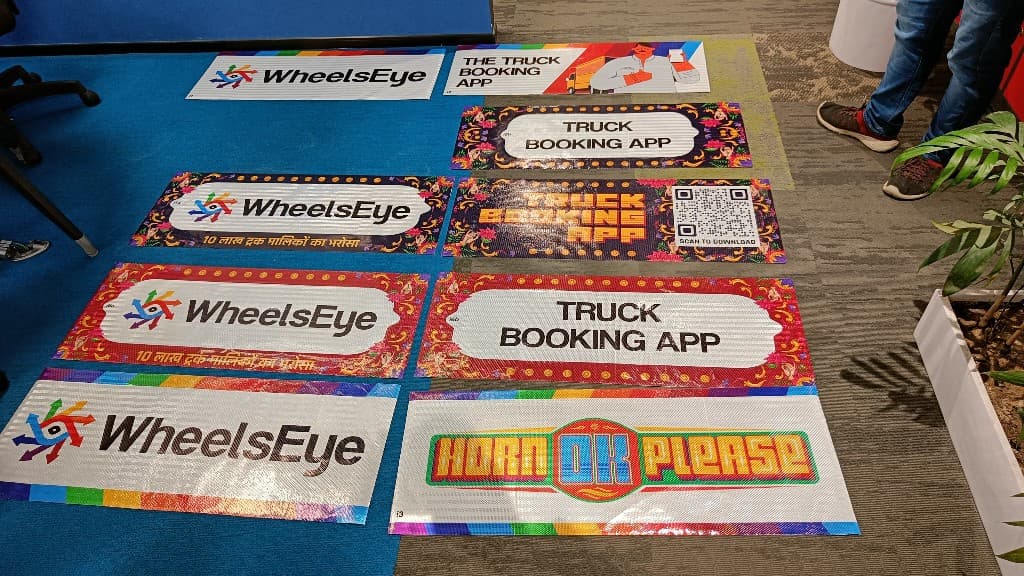
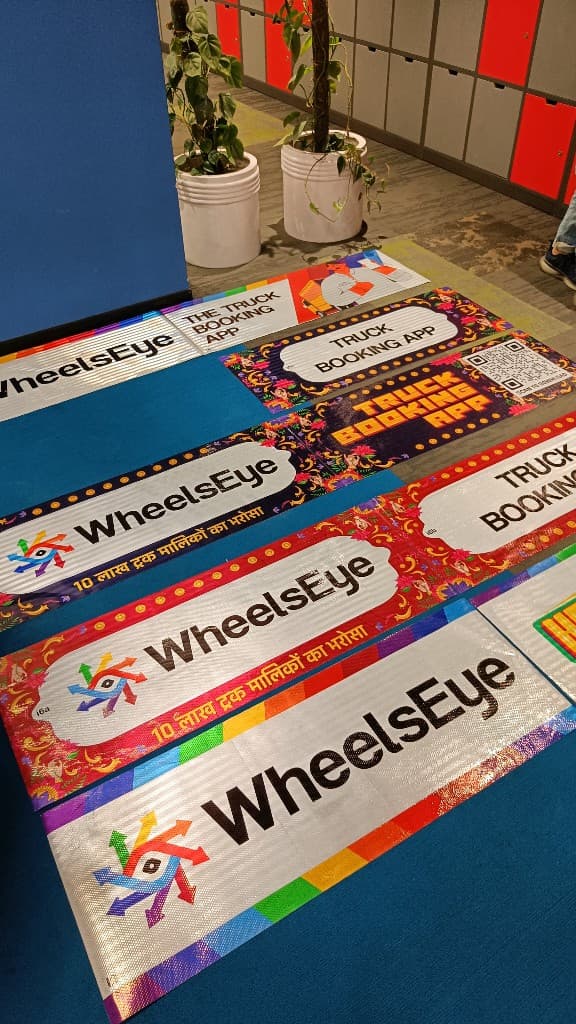
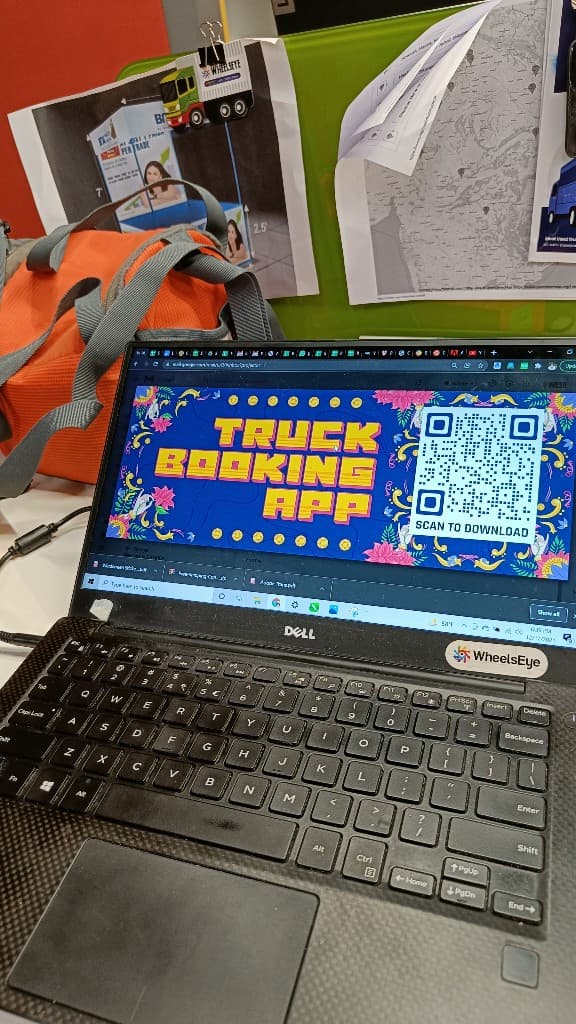
When we launched the WheelsEye truck booking app, we created a dedicated "Book a Truck" sticker campaign. And this is when things went from impressive to explosive. The phone number sticker had been the warm-up. The app download sticker was the main act.
By this point, we had figured out the ideal truck, the ideal profile of a vehicle that would maximize our sticker's impact. We knew where to find these trucks. We knew how to convince the owners. We had refined every step of the playbook through thousands of on-ground interactions.
We had turned trucks into a media channel. A walking billboard network that covered every national highway, every state highway, every industrial corridor in India.
When Competitors Followed
The ultimate validation came not from our own metrics, but from our competition.
They copied us. Every single one of them, eventually, started putting stickers on trucks. They followed our playbook. Same idea, same channel, same placement.
And here's the beautiful irony: because we were the first movers, because we had saturated the market for years before anyone else tried, our competitors ended up becoming exactly what we had been in the early days. "Just another company putting stickers on trucks." Just another brand trying to be WheelsEye.
They were not WheelsEye. And everyone knew it.
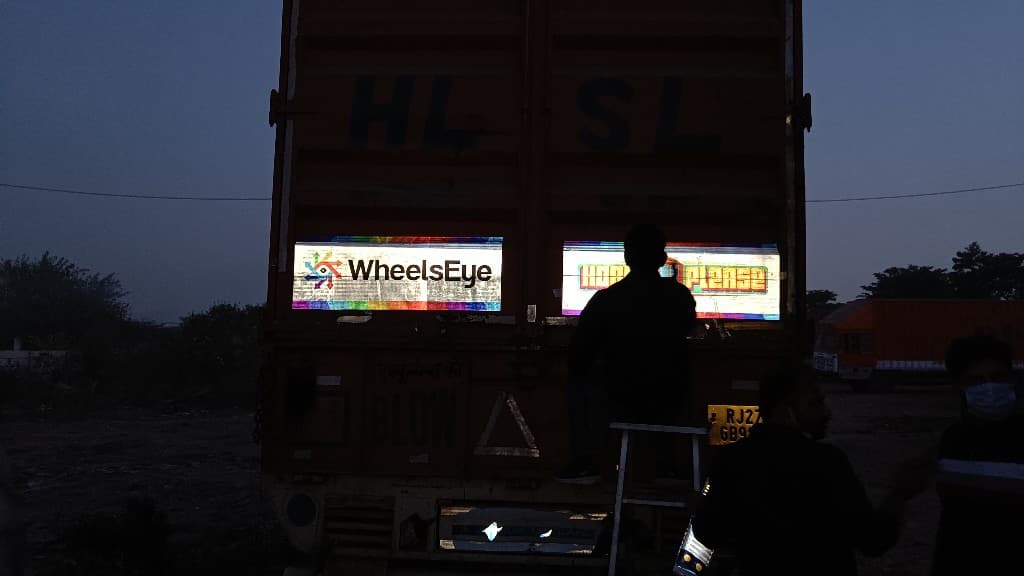
The first-mover advantage in this channel was permanent. It wasn't like digital marketing where anyone can outbid you for the same keywords. This was physical. Every truck with a WheelsEye sticker was a truck that had been seen by thousands of people for months or years before any competitor entered the game. By then, people already associated trucks with us.
The Vendors Who Became Partners
A small but important part of this story is about our vendors: the printers, the material suppliers, the people who made the physical production possible.
We did not have NDAs with them. We did not have non-compete agreements. There was no legal binding that prevented them from working with our competitors.
And yet, for the entire duration that we were actively running this program, not a single one of our vendors worked with the competition. They refused. The volume of work they were getting from us was so substantial, so consistent, and the relationship so strong, that they chose loyalty over diversification, without any contractual obligation to do so.
Some of our vendors became genuinely wealthy from this project. And I'm proud of that. We created economic value not just for WheelsEye but for the entire ecosystem around us.
It was only when we eventually paused the campaign, a strategic decision by Manish, our founder, who recognized that the brand promise had outpaced the business promise and we needed the business to catch up, that the vendors started serving other clients. And that's fair. I respect it completely.
The Art Experiments
Once the sticker program was a proven success, we started experimenting further. We painted trucks, fully painted, elaborately designed trucks that revived the Indian truck art tradition. We did 10-15 of these. Each one was a moving piece of art.
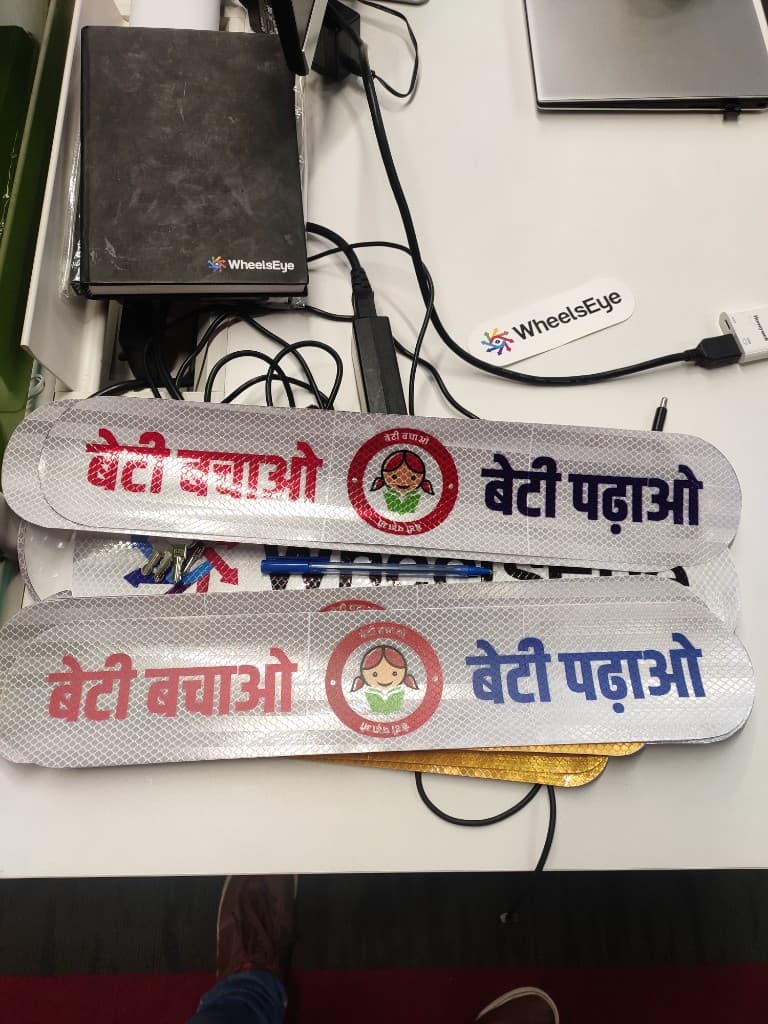
We created decorative reflective stickers, the kind that were not just functional but beautiful. We painted an entire truck and ran it around the city for brand visibility.
But here's the thing: we didn't publicize any of this. We didn't wave our own flag. We didn't write press releases about how innovative our marketing was. We were just doing the work. Heads down, executing, iterating, improving. The work spoke for itself on every highway in the country.
It is only now, with some distance and some time, that I'm sitting down to compile this story. To put it into words. To give it the documentation it deserves.
The Numbers
If you traveled on Indian roads between 2023 and 2026, or even now, there is a near-100% chance you saw a WheelsEye truck. That is not an exaggeration. That is the scale we achieved.
2017-2020
The Invisible Years
No marketing team. No brand visibility. Business growing at 10x every 9-10 months through pure product and sales effort.
2020
30 Experiments, Zero Results
Six months of rapid experimentation across every marketing channel. None delivered satisfactory ROI.
2020-2021
The Sticker Hypothesis
Idea conceived, debated, researched. Field studies, material testing, design iterations, budget approval.
2021
First 10,000 Stickers
Nationwide deployment. Months of silence. Then: "Spotted in Salem." The tipping point.
2021-2023
Scale and Iteration
Multiple batches. 16 designs. App download campaigns. 50,000+ downloads. Industry-wide recognition.
2023-2026
The Moat
Competitors follow. But the brand is already anchored. WheelsEye is synonymous with trucks in India. The campaign continues to compound.
Total investment over the project duration: double-digit crores. ROI: roughly 100x by our assessment, once you account for brand authority, trust, inbound recognition, app downloads, sales conversion improvement, and the competitive moat. None of it was possible through any other channel at any price point. And alongside the commercial return, thousands of trucks carried reflective markings that made them easier to see after dark.
"We didn't invent truck branding. We just did it with more rigor, more persistence, and more honesty than anyone thought was necessary for a sticker."
The Team
It would be too cheap if I took all the credit for this. I won't do that, because it wouldn't be true.
The initial idea was conceived by Lavish. The execution on the ground was driven by hundreds, eventually thousands, of people. But there was a core group that poured their hearts into this, and I need to name them.
Rishabh and Shivangi were phenomenal. Absolutely phenomenal. Both of them had their own full-time responsibilities. Rishabh had his own work to do. Shivangi had her own work to do. But they showed up for this project every single day, above and beyond their regular duties, because they believed in it.
Kushal. Somya. Abhinav. All of them poured their hearts into this.
And at the top, Anshul and Manish, the founders, who backed this initiative, cleared the budget, took the risk, and trusted us to execute. It was Manish who later made the mature strategic call to pause the campaign when the brand had outpaced the business. That kind of discipline is rare.
And then there were 600-700 people across WheelsEye who rallied around this. Who spotted trucks and shared photos. Who installed stickers in the field. Who answered calls from confused ground teams. Who took pride in seeing their company's name on every highway in India.
This was one of those rare projects where everyone actually showed up. Mind, body, vision, and mission became one. Everyone was in it. Everyone executed. And the result was something that belongs to all of us.
A ₹35 Sticker, 100x Returns, and Lives Saved at Night
If you happen to run into somebody who is even an inch deep in Indian logistics, talk to them about WheelsEye. They'll know. They'll have a story. And hopefully, they'll tell you the good sides of it.
What started as a simple question, "What if we put a sticker on the back of a truck?" became one of the most successful, most efficient, and most enduring brand-building exercises in Indian logistics history. It evolved through failure, field research, material testing, and thousands of honest conversations with truck owners who cared less about our logo and more about not getting rear-ended on a highway.
The sticker cost ₹35. The reflective material stayed on through heat, rain, and dust. The phone number was purchased for memorability. The placement on the back put our brand where other truckers looked, and put reflectivity where headlights needed it. The campaign was measured by WhatsApp messages from relatives in tier-2 towns, and by owners who said yes because a court case was the one outcome they were trying to avoid.
The ROI was about 100x. The safety benefit was harder to count, but real every night on the road.
I'm proud of this. It is a highlight of my life. And I'm grateful to WheelsEye for being the platform, to the founders for the trust, to the team for the execution, and to the thousands of trucks that carried our name across every road in India.
© Sonesh Jain · soneshjain.com